US Foreign Policy
Course syllabus
Course Summary
This course focuses on the development of US foreign policy over the course of the twentieth and twenty-first centuries. It will provide a brief background on the history of US foreign policy before 1900, but will focus primarily on the developments and issues occurring from 1900 through the present. The historical content of the course will be supplemented by introducing students to political science literature that can help to identify and explain key events and trends in US foreign policy during this time period.
Course Objectives
- The overarching goal is to develop an understanding of the systematic forces that shape US foreign policymaking. Please note that this is different than prescribing what policy should be (though this is also an important consideration when considering our motivations for studying the topic and reading course materials.
- Identify the key actors that influence foreign policy.
- Understand how and when the influence of actors varies (e.g. across time, issue area, etc.).
- Identify the key issues confronting policymakers and society.
- Identify general trends in US foreign policy over time.
- What’s changed?
- What stays the same?
- When and why do we see changes in behavior or policies?
- Students should develop a familiarity with social science research processes, practices. Specifically, students should have:
- A basic understanding of how to read social scientific research articles.
- A basic understanding of research design considerations
- A basic understanding of what the scope and limitations of research articles
Course Format
The course will be part lecture and part student participation. I encourage students to ask questions if the readings of lecture materials are unclear. In addition to class lectures students will be responsible for keeping up with readings and other class-related material as the semester progresses.
Required Books
There are three required books and several required articles (listed below in the course schedule). You can view the full citation in the reference list at the end of hover your cursor over the citation below for a preview of the full title.
Additional Readings
Students should also make an effort to stay informed on current events. Below are a some examples of good sources for keeping up with global events. Please note that some of these publications may be pay-walled, but you should have access through the university library.
Course Requirements
- Attendance: 10%
A major component to being successful in this class is just showing up. Every topic we cover will build upon ideas, lessons, themes, etc., that we covered in previous weeks. To do well you must be present.
- Collaborative Discussion: 20%
While the course has a heavy lecture component students will also spend time reflecting on class materials and discussing that material with classmates. We will use a combination of small group discussions and a Think-Pair-Share format—Students will have an opportunity to reflect on the course material independently, discuss the material with a classmate, and then communicate a summation of that discussion with the rest of the class. Students will then submit the notes from their discussion for review and grading. Accordingly, use the notes to keep track of the content of the discussion, ideas that emerge, and any lingering questions that might arise.
- Content Quizzes: 20%
There will be 6-8 content quizzes throughout the semester and they will cover material we have already reviewed through readings, lectures, and discussion. I will announce these ahead of time. All quizzes are open book and open note assignments and will be completed through Canvas. I will also identify the appropriate readings corresponding to each quiz so you do not have to worry about guessing.
- DAG Exercise: 20%
One of the things that separates the social sciences from punditry is the effort to be more precise in our understand of social phenomena. One tool that helps us to both crystallize our own thinking, and to communicate our thinking to others, is the directed acyclic graph (i.e. DAG). More casually, this is known as a causal graph. A DAG is simply a collection of nodes, which represent individual variables, and arrows, which represent causal ties. DAGs can range from relatively simple, to complex in structure, but they can all help us to identify causal relationships and develop model specifications to test those relationships.
Students should choose three readings to serve as a basis for their DAG assignment. These readings should also be from separate weeks and NOT from the same week. Rather, don’t wait to the last week of class to cram in three DAG assignments.
Each DAG assignment will consist of the following parts:
Question: After reading one of our in-class reading assignments (article, book, etc.) students will identify a new research question. This should aim to clearly articulate a specific question on which we can structure a research project.
Objective: What is the objective of the research question? Students should clearly describe the goal and the scope of the proposed question/analysis.
Estimand: Borrowing from Lundberg, Johnson, and Stewart (2021), the estimand consists of 1) a unit-specific quantity, and 2) a description of the target population. Importantly, you must explain how this estimand relates to your research question. Is it an appropriate measure given your question?
DAG: Using the Dagitty web platform draw the DAG outlining the relationships between the outcome of interest, key predictor variable, and other relevant variables (e.g. confounders).
Narrative: This is where you explain how the variables are related to one another. The DAG is useful insofar as it tells us which variables are related, but it doesn’t make clear how one affects another. This is where theory becomes important.
The Music of Foreign Policy Wiki: 30%
The arts are a powerful tool for communicating ideas across space and time, and are often deeply rooted in the politics of the moment. Over the last century music has increasingly come to serve as a vehicle for political speech, both reflecting and driving politics in the modern era. To that end, students will work together in small groups to build a Wiki-style page presenting a song or album that relates to US foreign policy in some way. The goal of this project is for students and their groups to build a wiki page on Canvas is dedicated to providing readers with a deeper understanding of the historical, political, and social underpinnings of songs. But there’s a catch—since this is a class on US foreign policy, these songs have to be related to US foreign policy in some way.
In general, each group’s wiki page should focus on the following points:
- Song/Album: Identify a song (or if you’re feeling ambitious, an entire album) that speaks to some aspect of US foreign policy.
- Issue: Identify the central issue, actors, policy, action, idea, behavior, etc., that is at the core of the song.
- Context: Once you have identified the central issue, provide some historical background information. This should help readers to better understand the social, political, and economic issues of the time period in question. Who are the key actors? What are the issues or policies of the time that serve as the focus for the song/album?
- Reception: How was the song/album received at the time of its release? Both critically and with respect to the popular impact that it had at the time?
- Legacy: What is the legacy of the song/album? How does its legacy compare with its impact at the time of its release?
This will serve as your final project. Accordingly, I expect the final content to be detailed, polished, and thoroughly proofed. Your grade will be broken up into components and there will be multiple checkpoints along the way. The schedule is detailed below.
Deadlines:
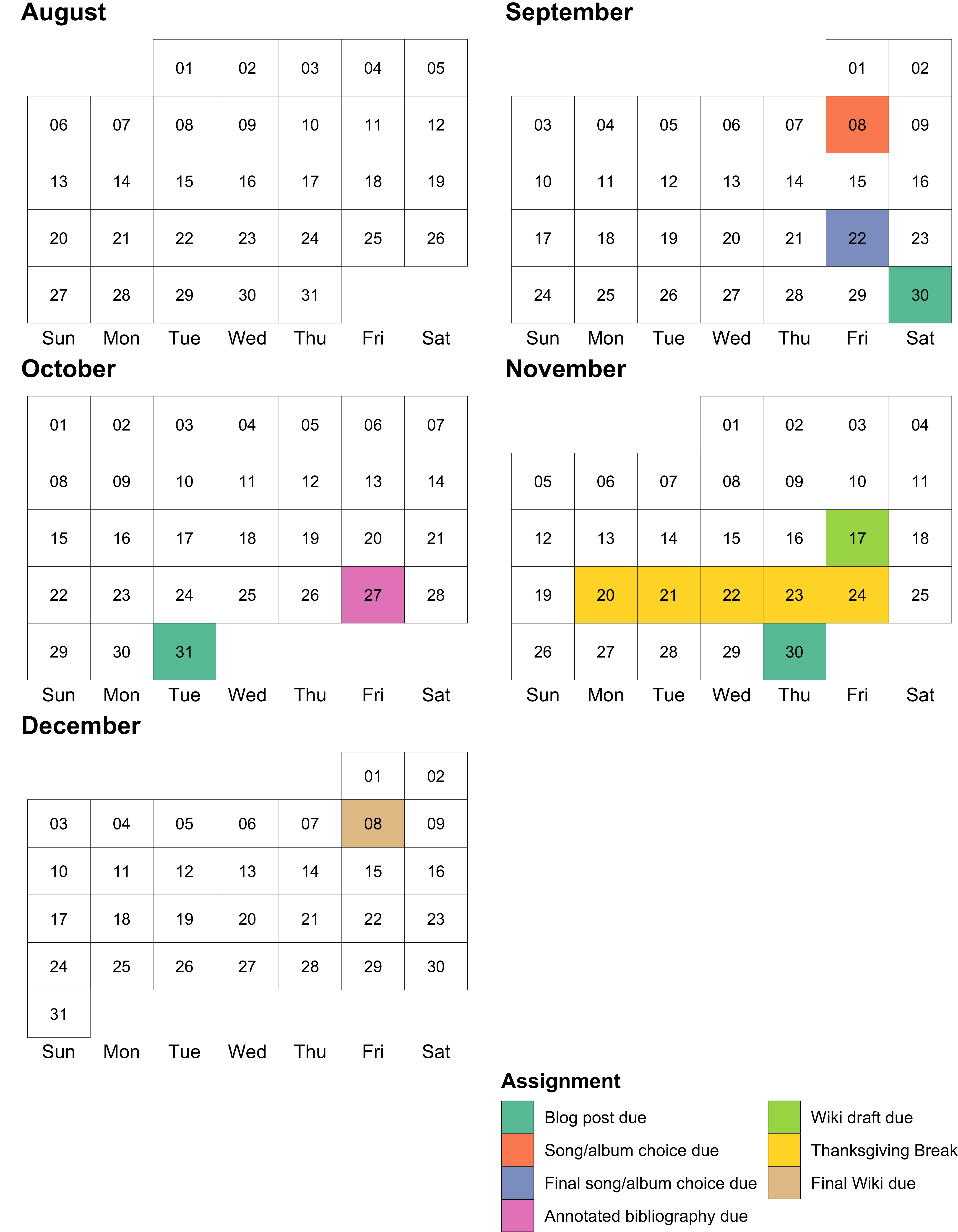
- September 9: Song/album choices due (2.5%)
- September 23: Final song/album selection due (2.5%)
- October 28: Annotated bibliography due (10%)
- November 18: Wiki draft due (5%)
- December 9: Final Wiki page due (10%)
Each iteration of this assignment should be drafted on Microsoft Word or Apple Pages, and submitted to Canvas.
Classroom Policies
Be kind. This might seem like an odd thing to list first, but I want to emphasize that this is not a normal class environment—this is still a time of unparalleled stress for many of us. We’re still in the middle of a global pandemic, many of us are still very much worried about our own health and safety, and many of us are very much worried about the health and safety of our coworkers, friends, and families. Let’s try to be cognizant of the fact that many of us (if not all) are going to be struggling at various points, and let’s work together to make this semester as educational and enjoyable as possible.
Be professional. We’re all here to learn, and many of the issues that we discuss have real-world impacts that affect people we know, or in our broader community. We’re here to work together to develop a better understanding of these issues.
Study guides and extra credit. The class is the study guide. I do not offer extra credit.
Grade Appeals. If you believe that I have given you an incorrect grade on an exam, you may submit a written appeal. All appeals must be in writing (they may not be made in person) and must contain an explanation for why the grade is incorrect. I will also require you to wait 24 hours after receiving a grade to submit a written appeal. Please note that even if your appeal is granted, I reserve the right to regrade the assignment in its entirety, meaning that your grade may go up or down depending on my reevaluation of the assignment.
The Syllabus. The syllabus is a living document that can and will be altered throughout the duration of the course based both on need and design. Generally, this may mean readings will be removed or added as needed. All changes will be listed on K-State Online, so make sure to check announcements for any such change. Additionally, I maintain the right to all of my own intellectual property presented in this course, whether it is the course lectures or this syllabus. Materials from this course ought not to be reproduced without my expressed permission.
Classroom conduct. All student activities in the University, including this course, are governed by the Student Judicial Conduct Code as outlined in the Student Governing Association By Laws, Article V, Section 3, number 2. Students who engage in behavior that disrupts the learning environment may be asked to leave the class.
Contacting the Instructor
The best way to get in touch with me is through email. Please do not hesitate to contact me if you have any questions about course content or your ability to complete the assigned material.
Final Grades
A: 90+
B: 80–89.99
C: 70–79.99
D: 60–69.99
F: 0–59.99
Tentative course schedule begins on next page
Tentative Course Schedule
Week 01, 08/21 - 08/25: Course Introduction
Readings and Assignments
- Watch video on how to read a social science research paper
Week 02, 08/28 - 09/01: Historical background
Readings and Assignments:
- Read Fordham (2019)
Week 03, 09/04 - 09/08: The Cold War and US Hegemony
Readings and Assignments:
- Read United States National Security Council (1950)
Week 04, 09/11 - 09/15: The Cold War and Domestic Politics
Readings and Assignments:
Week 05, 09/18 - 09/22: The Presidency and Congress
Readings and Assignments:
- Read Rosenwasser et al. (2017, chap. 13)
- Read Lupton (2017)
Week 06, 09/25 - 09/29: The Policymaking Process
Readings and Assignments:
- Read Rosenwasser et al. (2017, chap. 1 and 2)
- Read Miller (2016)
Week 07, 10/02 - 10/06: The Bureaucracy / The State Department
Readings and Assignments:
- Read Keane and Diesen (2015)
- Read Rosenwasser et al. (2017, chap. 4)
Week 08, 10/09 - 10/13: The Defense Department and the Military
Readings and Assignments:
- Read Karlin (2021)
Week 09, 10/16 - 10/20: The Use of Military Force
Readings and Assignments:
Week 10, 10/23 - 10/27: Security Cooperation
Readings and Assignments:
- Read Allen et al. (2022)
Week 11, 10/30 - 11/03: Trade, Immigration, Finance, and Monetary Policy
Readings and Assignments:
- Read O’Neil (n.d.)
Week 12, 11/06 - 11/10: Trade, Immigration, Finance, and Monetary Policy (cont.)
Readings and Assignments:
- Read McDowell (2023)
Week 13, 11/13 - 11/17: Foreign Aid
- Read Rosenwasser et al. (2017, chap. 5)
- Read Nachega et al. (2023)
- Read Fidler (n.d.)
Week 14, 11/20 - 11/24: Thanksgiving Break (No Class)
Readings and Assignments:
- Get some rest
- Enjoy yourselves
- Eat good food
- Take a good nap
Week 15, 11/27 - 12/01: Human Rights Issues
Readings and Assignments:
Week 16, 12/04 - 12/08: Multilateralism and global governance
Readings and Assignments:
References
Allen, Michael A., Michael E. Flynn, Michael E. Martinez Machain, and and Andrew Stravers. 2022. Beyond the Wire: US Military Deployments and Host Country Public Opinion. Oxford, New York: Oxford University Press.
Ballvé, Teo. 2009. “The Dark Side of Plan Colombia.” The Nation.
Busby, Joshua W. 2020. “What International Relations Tells Us about COVID-19.” E-International Relations.
Diamond, Dan. 2023. “Lifesaving HIV Program Faces a New Threat: U.S. Abortion Politics.” Washington Post.
Dudziak, Mary L. 2004. “Brown as a Cold War Case.” The Journal of American History 91(1): 32–42. https://www.jstor.org/stable/3659611 (August 18, 2021).
Fajardo-Heyward, Paola. 2015. “Understanding the Effect of Security Assistance on Human Rights: The Case of Plan Colombia.” The Latin Americanist 59(2): 3–27.
Fidler, David P. A New U.S. Foreign Policy for Global Health. Council on Foreign Relations.
Fordham, Benjamin O. 2007. “The Evolution of Republican and Democratic Positions on Cold War Military Spending.” Social Science History 31(4): 603–36.
———. 2019. “The Domestic Politics of World Power: Explaining Debates over the United States Battleship Fleet, 1890–91.” International Organization 73(02): 435–68.
Karlin, Mara E. 2021. The Inheritance: America’s Military After Two Decades of War. Washington: Brookings Institution Press.
Keane, Conor, and Glenn Diesen. 2015. “Divided We Stand: The US Foreign Policy Bureaucracy and Nation-Building in Afghanistan.” International Peacekeeping 22(3): 205–29.
Lundberg, Ian, Rebecca Johnson, and Brandon M. Stewart. 2021. “What Is Your Estimand? Defining the Target Quantity Connects Statistical Evidence to Theory.” American Sociological Review 86(3): 532–65.
Lupton, Danielle L. 2017. “Out of the Service, Into the House: Military Experience and Congressional War Oversight.” Political Research Quarterly 70(2): 327–39.
McDowell, Daniel. 2023. Bucking the Buck: US Financial Sanctions and the International Backlash Against the Dollar. Oxford, New York: Oxford University Press.
Miller, Paul D. 2016. “Graveyard of Analogies: The Use and Abuse of History for the War in Afghanistan.” Journal of Strategic Studies 39(3): 446–76.
Nachega, Jean B. et al. 2023. “PEPFAR at 20 — A Game-Changing Impact on HIV in Africa.” New England Journal of Medicine 389(1): 1–4.
O’Neil, Shannon K. “America’s Supply Chains Are Foreign Policy Now.” Foreign Policy.
Rosenwasser, Jon J. et al. 2017. The National Security Enterprise: Navigating the Labyrinth. Second edition. eds. Roger Z. George and Harvey Rishikof. Washington, DC: Georgetown University Press.
Schultz, Kenneth A. 2017. “Perils of Polarization for U.S. Foreign Policy.” The Washington Quarterly 40(4): 7–28.
United States Government. 2019. Divided Responsibility: Lessons from U.S. Security Sector Assistance Efforts in Afghanistan. Special Inspector General for Afghanistan Reconstruction.
United States National Security Council. 1950. NSC-68. United States Government.