US Foreign Policy
Course syllabus
Course Summary
This course focuses on the development of US foreign policy over the course of the twentieth and twenty-first centuries. It will provide a brief background on the history of US foreign policy before 1900, but will focus primarily on the developments and issues occurring from 1900 through the present. The historical content of the course will be supplemented by introducing students to political science literature that can help to identify and explain key events and trends in US foreign policy during this time period.
Course Objectives
- The overarching goal is to develop an understanding of the issues and systematic forces that shape US foreign policymaking. Please note that this is different than prescribing what policy should be (though this is also an important consideration when considering our motivations for studying the topic and reading course materials).
- Identify the key actors that influence foreign policy.
- Understand how and when the influence of actors varies (e.g. across time, issue area, etc.).
- Identify the key issues confronting policymakers and society.
- Identify general trends in US foreign policy over time.
- What’s changed?
- What stays the same?
- When and why do we see changes in behavior or policies?
- Students should develop a familiarity with social science research processes, practices. Specifically, students should have:
- A basic understanding of how to read social scientific research articles.
- A basic understanding of research design considerations
- A basic understanding of what the scope and limitations of research articles
Course Format
The course will be part lecture and part student participation. I encourage students to ask questions if the readings of lecture materials are unclear. In addition to class lectures students will be responsible for keeping up with readings and other class-related material as the semester progresses.
Required Books
There are three required books and several required articles (listed below in the course schedule). You can view the full citation in the reference list at the end of hover your cursor over the citation below for a preview of the full title.
Additional Readings
Students should also make an effort to stay informed on current events. Below are a some examples of good sources for keeping up with global events. Please note that some of these publications may be pay-walled, but you should have access through the university library.
Course Requirements
- Attendance: 15%
A major component to being successful in this class is just showing up. Every topic we cover will build upon ideas, lessons, themes, etc., that we covered in previous weeks. To do well you must be present.
Life also happens, and so students will be given three class periods to miss without penalty. After that, students will be given an attendance grade based on the proportion of classes attended relative to the total number of classes.
- Collaborative Discussion: 25%
While the course has a heavy lecture component students will also spend time reflecting on class materials and discussing that material with classmates. We will use a combination of open discussion and small group discussions. Students will be required to submit 2 discussion questions to Canvas prior to the class discussion meeting for a given topic. Students will be graded on a combination of the quality of the questions they submit, but also on the quality of their in-class contributions.
- Exams: 30%
There will be 3 short exams throughout the semester and they will cover material we have already reviewed through readings, lectures, and discussion. All exams are open book and open note assignments and will be completed through Canvas.
- Crisis Simulation: 30%
During the final week of the semester students will participate in a crisis simulation. The goal of this simulation is to provide students with an opportunity to apply the knowledge that they have acquired throughout the semester to a simulated crisis requiring the attention of US foreign policymakers.
Prior to the simulation students will be assigned a particular role for the simulation activity. For example, one student will be the President, another will be the Secretary of State, another will be the Secretary of Defense, etc. Students will be expected to prepare for the simulation by reading background materials and preparing a briefing for the President on their assigned topic. Each student should have a list of questions and proposals for the president to consider.
Students will ultimately be evaluated on their contributions during the simulation meetings, as well as on the basis of a reflection paper that will be due at the conclusion of the simulation.
Classroom Policies
Be kind. College can be stressful. Many of you are working jobs in addition to attending class. Some of you may also be responsible for the care of family members. Whatever your situation, let’s work together to make this semester as educational and enjoyable as possible.
Be professional. We’re all here to learn, and many of the issues that we discuss have real-world impacts that affect people we know, or in our broader community. We’re here to work together to develop a better understanding of these issues.
Study guides and extra credit. The class is the study guide. I do not offer extra credit.
Grade Appeals. If you believe that I have given you an incorrect grade on an exam, you may submit a written appeal. All appeals must be in writing (they may not be made in person) and must contain an explanation for why the grade is incorrect. I will also require you to wait 24 hours after receiving a grade to submit a written appeal. Please note that even if your appeal is granted, I reserve the right to regrade the assignment in its entirety, meaning that your grade may go up or down depending on my reevaluation of the assignment.
The Syllabus. The syllabus is a living document that can and will be altered throughout the duration of the course based both on need and design. Generally, this may mean readings will be removed or added as needed. All changes will be listed on K-State Online, so make sure to check announcements for any such change. Additionally, I maintain the right to all of my own intellectual property presented in this course, whether it is the course lectures or this syllabus. Materials from this course ought not to be reproduced without my expressed permission.
Classroom conduct. All student activities in the University, including this course, are governed by the Student Judicial Conduct Code as outlined in the Student Governing Association By Laws, Article V, Section 3, number 2. Students who engage in behavior that disrupts the learning environment may be asked to leave the class.
Contacting the Instructor
The best way to get in touch with me is through email. Please do not hesitate to contact me if you have any questions about course content or your ability to complete the assigned material.
Final Grades
A: 90+
B: 80–89.99
C: 70–79.99
D: 60–69.99
F: 0–59.99
Tentative course schedule begins on next page
Tentative Course Schedule
Week 01, 08/25 - 08/29: Course Introduction and Historical Background
Readings and Assignments
Week 02, 09/01 - 09/05: Historical background (cont.)
Readings and Assignments:
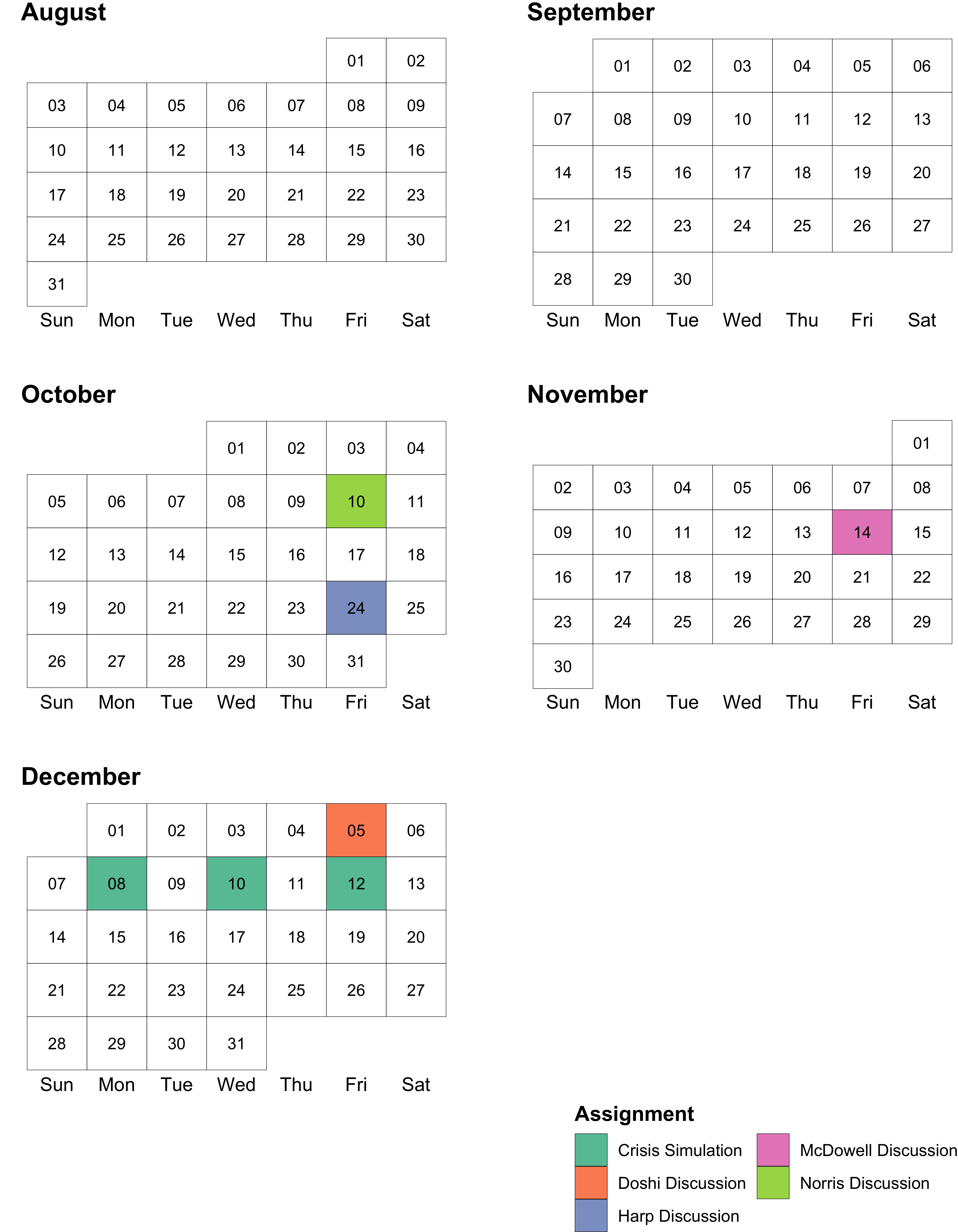
Friday 09/05: Discussion Day
Week 03, 09/08 - 09/12: The Cold War and US Hegemony
Readings and Assignments:
- United States National Security Council (1950)
- Sources, Conduct, and Kennan (1947)
- The Truman Doctrine
Week 04, 09/15 - 09/19: The Cold War and Domestic Politics
Readings and Assignments:
Friday 09/19: Discussion Day
Readings from Cold War lectures:
- United States National Security Council (1950)
- Sources, Conduct, and Kennan (1947)
- The Truman Doctrine
- Dudziak (2004)
- Fordham (2007)
Week 05, 09/22 - 09/26: The Presidency and Congress
Readings and Assignments:
Week 06, 09/29 - 10/03: The Policymaking Process
Readings and Assignments:
- Read Miller (2016)
Week 07, 10/06 - 10/10: The Bureaucracy / The State Department
Readings and Assignments:
- Read Norris (2021)
Friday 10/10: Discussion Day
- Norris (2021)
Week 08, 10/13 - 10/17: The Defense Department and the Military
Readings and Assignments:
- No readings or discussion
Week 09, 10/20 - 10/24: Bureaucracies, State Department, and Department of Defense, Cont.
Readings and Assignments:
Week 10, 10/27 - 10/31: The Use of Military Force
Readings and Assignments:
Friday 10/31: Discussion Day
- Read @Seth Harp (2025)
- Modern War Institute Podcast: Bunker Busters and B-2s
Additional selected readings:
Week 11, 11/03 - 11/07: Security Cooperation
Readings and Assignments:
- Council on Foreign Relations: U.S. Aid to Israel in Four Charts
- Council on Foreign Relations: Here’s How Much Aid the United States Has Sent Ukraine
- Center for Strategic and International Studies: Can Ukraine Fight Without U.S. Aid? Seven Questions to Ask
- Congressional Research Service: Transfer of Defense Articles: U.S. Sale and Export of U.S.-Made Arms to Foreign Entities
- The Conversation: Why does the US pay so much for the defense of its allies? 5 questions answered
- The Conversation: The US military presence in Europe has been declining for 30 years – the current crisis in Ukraine may reverse that trend
Friday 11/07: Discussion Day
- Council on Foreign Relations: U.S. Aid to Israel in Four Charts
- Council on Foreign Relations: Here’s How Much Aid the United States Has Sent Ukraine
- Center for Strategic and International Studies: Can Ukraine Fight Without U.S. Aid? Seven Questions to Ask
- Congressional Research Service: Transfer of Defense Articles: U.S. Sale and Export of U.S.-Made Arms to Foreign Entities
- The Conversation: Why does the US pay so much for the defense of its allies? 5 questions answered
- The Conversation: The US military presence in Europe has been declining for 30 years – the current crisis in Ukraine may reverse that trend
Week 12, 11/10 - 11/14: Trade, Finance, and Monetary Policy
Readings and Assignments:
Possible Guest Lecture with Sarah Jacobson on US sanctions policy.
Week 13, 11/17 - 11/21: Trade, Finance, and Monetary Policy (cont.)
Readings and Assignments:
- McDowell (2023)
Friday 11/21: Discussion Day
- McDowell (2023)
- Paul Musgrave: Oh no, I betrayed America
Week 14, 11/24 - 11/28: Thanksgiving Break (No Class)
Readings and Assignments:
- Get some rest
- Enjoy yourselves
- Eat good food
- Take a good nap
Week 15, 12/01 - 12/05: Human Rights Issues
Readings and Assignments:
Power (2001)
Friday 12/05: Discussion Day
Power (2001)
Week 16, 12/08 - 12/12: Crisis Simulation
Monday, December 8, 2025
- Introduce crisis simulation
- Provide overview of the crisis scenario
- Students present initial positions to the President
Wednesday, December 10, 2025
- Review proposals
- Clarify obstacles, risks, benefits, opportunities, threats, etc.
- Evaluate positions
Friday, December 12, 2025
- Narrow the options
- Provide final recommendations to the president
References
Doshi, Rush. 2023. The Long Game: China’s Grand Strategy to Displace American Order. New York: Oxford University Press.
Dudziak, Mary L. 2004. “Brown as a Cold War Case.” The Journal of American History 91(1): 32–42. https://www.jstor.org/stable/3659611 (August 18, 2021).
Fordham, Benjamin O. 2007. “The Evolution of Republican and Democratic Positions on Cold War Military Spending.” Social Science History 31(4): 603–36.
Lupton, Danielle L. 2017. “Out of the Service, Into the House: Military Experience and Congressional War Oversight.” Political Research Quarterly 70(2): 327–39.
McDowell, Daniel. 2023. Bucking the Buck: US Financial Sanctions and the International Backlash Against the Dollar. Oxford, New York: Oxford University Press.
Miller, Paul D. 2016. “Graveyard of Analogies: The Use and Abuse of History for the War in Afghanistan.” Journal of Strategic Studies 39(3): 446–76.
Norris, John. 2021. The Enduring Struggle: The History of the U.S. Agency for International Development and America’s Uneasy Transformation of the World. Lanham, Maryland Boulder, Colo. New York,NY London: Rowman & Littlefield Publishers.
Power, Samantha. 2001. “Bystanders to Genocide: Why the United States Let the Rwandan Tragedy Happen.” The Atlantic Monthly: 84–108.
Seth Harp. 2025. The Fort Bragg Cartel: Drug Trafficking and Murder in the Special Forces. Penguin Random House.
Sources, The, Soviet Conduct, and George F Kennan. 1947. “The Sources of Soviet Conduct.” Foreign Affairs 25(4): 566–82.
United States Government. 2019. Divided Responsibility: Lessons from U.S. Security Sector Assistance Efforts in Afghanistan. Special Inspector General for Afghanistan Reconstruction.
United States National Security Council. 1950. NSC-68. United States Government.
Weissman, Stephen R. 2017. “Congress and War: How the House and the Senate Can Reclaim Their Role.” Foreign Affairs 96(1): 132–45. https://www.jstor.org/stable/44823238 (August 18, 2025).